
Monday, February 6, 2012
New Survival Blog
Our friends Chris and Rob have started making a name for themselves. They are running The Average Joe Survivalist, a survival blog that covers a wide range of topics, from stocking up for emergencies, to surviving a SHTF scenario, to concealed weapon and gear reviews, and everything in between. These guys know their stuff, they have real-world experience and training to base their articles on. The information is concise, complete, and valid. Pay them a visit, and add their site to your "bookmarks" list, as they keep new articles coming at a steady pace!

Wednesday, January 4, 2012
AR15 Pistols
Okay, so let’s talk about one of the most fun, loud, and
obnoxious things out there. I don’t care if your name is Paul, you wear your
hat crooked, and you are the life of the party every Saturday night. You will
still never be more fun, loud, or obnoxious than an AR-15 Pistol (aka MI Pistol
or AR Pistol). For legal purposes, I will clarify that AR-15 Pistols are legal
in the state of Michigan as long as they adhere to a few guidelines, the
biggest being it cannot have a stock. So to say the least, we are reviewing a
weapon that is legal in our state. Please review your state laws if you have
interest in this type of weapon before making plans to build or purchase.

To start off, there are a great deal of benefits to having
one of these little guys. One of them is the carry facet. I know it may sound
ludicrous to carry one of these things, but since they are required to be
registered as pistols in the state of MI they receive all of the same rights
and privileges as a pistol. I, personally, every now and then carry my AR
Pistol under my knee length trench coat with a BlackHawk single-point sling.
With either my 7” or 7.5” barrel I can still carry this thing without it being
noticed. With its legal versatility as a pistol you can also use it as a “truck
gun” or in my case a “four-door sedan gun”. This also makes it easier to take
it to the range since you can keep it loaded.
The next best thing about AR Pistols is shooting them. Getting
the right sights for them is quite the pain, which we will discuss later, but
target/scenario shooting is a blast, quite literally. If shooting one handed,
which makes even the scroniest of a man feel like Gaston, you do have a liberal
amount a muzzle lift, even with special muzzle brakes. Yet, the weight of the
gun and AR-15 trigger pull does allow you enough time to fire somewhat rapidly
and still be on target. You aren’t shooting a tournament 1911, but for
one-handed shooting, with a weapon not originally designed for one-handed
shooting, it does fairly decent. Now, two-handed shooting makes you feel a
little like Tony Montana. I can’t tell you how many times I have introduced
mine by saying, “Say hello to my little friend.” I know, I know, he used an A2
style M-16 with a M203, but I can’t help myself.

Recoil wise, they are basically like shooting a short AR-15,
which ironically enough is what they are. Accuracy wise, I would say at
twenty-five yards they are as accurate as any other handgun I have fired from a
standing position. I do not know how these weapons perform at long distances.
Mainly because I treat it as a pistol and I would not call upon my pistol to
make one-hundred yard shots unless I was left without the option of using my
rifle. One day I may see how it does with long range shots, but then again,
what did I buy my LR-308 for? I my opinion, in a tactical scenario these things
work best at providing short range suppressive fire, but one can’t forget about
the long range capabilities of the 5.56.
With these weapons having all of their good sides, why don’t
we take a stroll down to the bad and the ugly. First of all, price, price, and
price. Without giving you the rundown of a parts list and prices, which don’t
fret, I will waste your time with that later, I will just say that for a basic
model using new parts you are going to spend about $850 to build an AR Pistol.
For those of you who build AR-15s, myself included, that is clearly more than
building a full size rifle. However, I must say that building an AR Pistol,
like building an AR-15, will in most cases save you money, which leads me to my
next point.

Getting the chance to build one of these is also a great
experience, but frustrating at the same time. I have built ARs before, but AR
Pistols have a little more complexity to them. The hand guard is somewhat of a
concern for 7” barrels. The 10.5” barrel use carbine length gas tubes and hand
guards so those are not a problem, but the shorter ones require slightly more
expensive parts. On the AR Pistol upper I built I used a Yankee Hill Machine Pistol
Length Quad Rail Free-float Handguard. This added enough weight to keep the
pistol somewhat balanced and made my sight conundrum slightly easier to solve. The
biggest issue with sights for an AR Pistol is that no manufacture has made AR
sights that work as well as standard pistol sights. My choice, or rather choices,
ended up being an EOTech EXPS3 on my Rock River Arms upper and MagPul flip
sights for my Palmetto State Armory/DPMS upper. Both have worked out great so
far as sights and serve their purpose for the pistol they are on.
Along with finding the right sights to fit your purposes,
there are other issues to be addressed in the construction of an AR Pistol.
These are functioning dilemmas. Now, that is not to say that AR Pistols are
inherently problematic, so don’t get it twisted. However, there are problems
that should be addressed. First and foremost is the buffer tube. If you take
your collapsible AR stock, pull down on the adjustment lever, and remove it you
will have a well functioning AR pistol buffer tube (although one must consider
the possible legal pitfall of having a buffer tube that could so readily accept
a stock). Ace makes a full length buffer tube that has worked flawlessly with
my AR pistol. The problem comes with the shorter tubes that some manufactures
have created. These look better and make the AR Pistol much shorter, but have
been reported to have many feeding issues due to the short amount of travel
that the bolt carrier has in between shots. The easiest way to put it is that
the more your buffer tube meets the standard length, the more reliable it will
be.
The next issue is that of business end of the barrel: the
muzzle brake. Many people will swear that the 7” barrels have feeding issues
due to the lack of backpressure created from the short length of the barrel.
Although I have used a standard “birdcage” A2 style flash hider with no feeding
issues, I had looked into a flash hider that would work to solve three
problems: low backpressure, high decibels, and muzzle flash. The device I used
was the DPMS Levang Compensator. I won’t give this item the same be-all end-all
rating that others have because every now and then you do get some muzzle flash
and it didn’t seem to “send the sound downrange” to the high extent that others
have reported, but with it I haven’t had any feeding problems and the muzzle
flash is not as extreme as with other flash hiders. For $30, I won’t down-talk
the item as it performed adequately. So far, nothing short of a silencer will
tame the excessive roar of these weapons, but with hearing protection, from my
perspective as the shooter, it didn’t sound any louder than your standard AR-15
while wearing proper hearing protection.

In short, considering the good, the bad, and the ugly, AR
Pistols are in my opinion great additions to any gun collection. With their
legal flexibility they make great vehicle weapons as well as intimidating carry
pieces whether you decide to CC or OC. Keep in mind, some states have odd laws
about these weapons, MI’s is odd, but benefiting to gun owners like me, but if one’s
state does not frown on them they will make their owner quite happy. They have
always been of interest to other shooters at the gun range and have made a few
of my buddies quite jealous. Below you will find the list of parts that went
into build each AR Pistol and feel free to email us with any question you may
have about your AR Pistol build. We may not know everything, but if you are
just starting out with your build we can most likely get your questions answered
and get you to the range.
- Ace Pistol Buffer Tube
- DPMS Bolt Carrier Assembly
- DPMS Crush Washer
- DPMS Levang Compensator
- DPMS Pistol Length Gas Tube
- DPMS Railed Gas Block
- DPMS Trigger Kit
- DPMS 7” Barrel
- Palmetto State Armory Assembled Upper Receiver and Charging handle
- Rock River Arms Stripped Lower Receiver
- Rock River Arms Upper Receiver Assembly (2nd AR Pistol upper)
- Yankee Hill Machine Pistol Length Quad Rail Free-float Handguard
Review: Glock 21SF
This is my fourth .45 caliber
handgun. Some would say I downgraded as I progressed. My first was a 1911, then
onto an M&P45, from there a Sig P220, and now the Glock 21SF. As the owner
of these weapons I can see their point. I loved my 1911, but the hammer follow
it developed, uncured by the local gunsmith, broke my trust in it. My M&P45
was an awesome carry piece and was the first of my semi-automatics that I
trusted to carry with a round in the chamber, but for some reason it still
didn’t fit the bill. The magazines were pricy, which I think may be my only
complaint. My Sig P220 was something I thought I could settle on. The all-metal
construction, ease of maintenance, and internal safety of the weapon had me
hooked. However, I ended up selling it so I could fund a new LR-308. So I
continued on and had the chance to obtain my first Glock, which was a G32
chambered for .357 Sig. Now this was a very nice carry gun, very simplistic,
and a pleasure to shoot. At this point I did not have a .45 and decided that it
was time to get one. More importantly, it was time to get a full-sized Glock
chambered for .45 ACP: The Glock 21.


This firearm was bought for about $560 at the local gun store and after putting a few rounds downrange with it, I realized something; To me, .45s are mostly created equal. Its recoil felt similar to that of my 1911, M&P45, and Sig P220, with just a slightly different trigger pull, but very comparable to the Sig. Immediately, I was right on target. I had to get used to the longer trigger pull, especially for rapid firing, but I felt like I was holding the same gun I learned to shoot with.

Breaking a gun reminds me of my
next point. I work hard for my income, and treat my possessions, especially
weapons, with respect. Therefore, I am content to report that I do not have a
destructive “torture test” to show you. The fact that it is a carry piece and
is virtually flawless is a testament to its ability to endure responsible gun
handling.


Sunday, December 25, 2011
Review: INFORCE WML

Many of you are familiar with the INFORCE brand, which has
gained a very strong reputation, particularly in Military and Law Enforcement
circles. Emissive Energy Corp., an
American corporation founded in 1991, produces INFORCE brand products. Emissive Energy is also responsible for
products under the INOVA brand name as well, until the brand was sold in
2010. This is all beside the point,
however.
INFORCE has recently released a new weapon light, simply
named the Weapon Mounted Light, or WML. Allow me to begin with some technical
details. The WML is just over 4” long,
the bezel is 1” in diameter, and the unit is stunningly lightweight, at a mere 3 ounces,
including the single CR123 battery. The
light has two output settings. On
“High”, the light puts out 125 lumens for about 2 hours on a fresh
battery. Set it on “Low”, and you get 30
lumens for 10 hours of continuous run time.
This light, while it may be small in size, does not lack any
of the features of it’s larger, heavier counterparts. Aside from the previously mentioned High and
Low output settings, the light features a strobe function. All of these features can be operated as constant-on
or momentary through the use of the single button on the back of the light. When I found that this light had all of these
features and only one button, I was expecting a catastrophe waiting to
happen. Picture someone’s home being
broken into, and instead of turning the light on momentarily, the homeowner is
fumbling, cycling through all of the “settings”, trying to find the one he’s
looking for. While this is going on,
he’s giving away his position, essentially painting a target on himself. . .
This couldn’t be farther from the truth. The operation of all the features of the
light are very intuitive. As with all new firearms and accessories, there is a learning curve, and some practice is required to "master" said items. Without the aid of an owner's manual or any form of instructions, I was able to comfortably activate all of the features this light has to offer within minutes of turning it on. As I said,
operation is very intuitive.
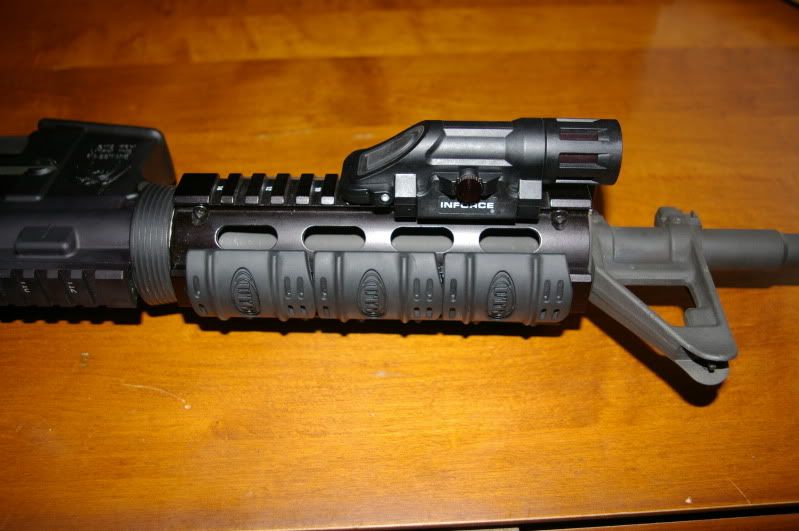
With all of the features this light has, it is no surprise
that a tape switch is not available. In
my opinion, one isn’t needed. On my
AR15, I mounted the light on the left side of the quad rail, right where my
thumb would normally rest. I was never
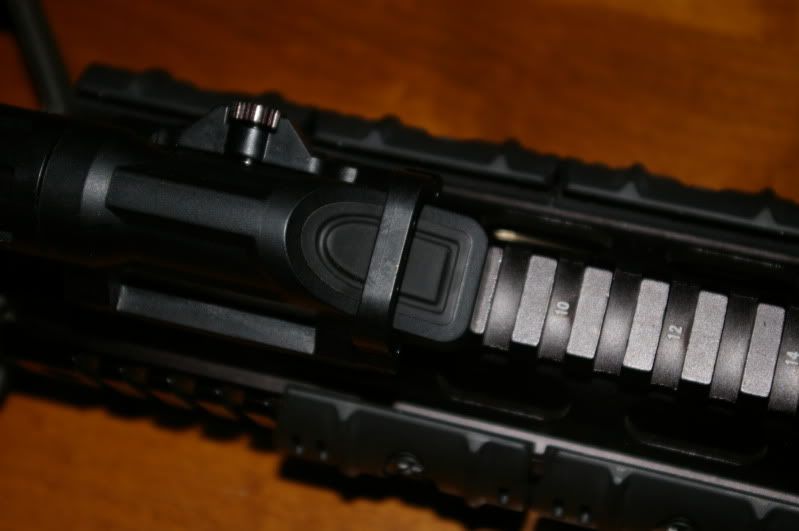
able to get used to a vertical or angled foregrips. The back of the WML is angled, with a large
button that is very easy to find and activate. The button also has a flip-up lockout lever that is intended to prevent accidental/unwanted activation of the light. It is a good idea in some cases, and solves the problem encountered by other tailcap switch equipped weapon lights. The beauty of this design is that such an idea is not needed here. The ergonomic design, combined with the shape of the button itself, prevents most all accidental light discharges. Palm strikes, bumping into walls, doors, etc., will not turn the light on. I found the lockout lever to be unnecessary, but it's shape and location do not detract from the use or aesthetics of the light in any way, as it is virtually unnoticeable unless it is in the "up" position, as pictured below. Even in this position, it is still possible to activate the light, it simply requires a more deliberate motion to do so.
The Breakdown:
Pros: Lightweight, bright, packed with features that some higher-priced models lack, available with IR illumination, black and tan colors available to match the light to your rig, battery consumption is on par with similar lights.
Cons: Lack of tape switch compatibility may be an issue for some.
Bottom Line: If you are looking for a rock-solid weapon light that won't add pounds to your weapon, look no further. The price is right when compared to comparable lights, and the features packed into this small package make it a great choice. Simple mounting, quick detach, intuitive operation, and power, all combined in a package that is less than 3 ounces.
I'd like to extend my gratitude to Rick at TacticalLEDs.com for the opportunity to review this product.
If you have a product you would like to see reviewed here, please contact us at thelowready@gmail.com
If you have a product you would like to see reviewed here, please contact us at thelowready@gmail.com
Wednesday, November 30, 2011
The Path to Silence (Or at least around 110 to 120 decibels)
Note: While there is
some debate among enthusiasts regarding the proper name for a
Silencer/Suppressor, for simplicity's sake, we have chosen to stick with the
name the ATF uses to classify this device.
When the news about Michigan’s new legislation regarding
Silencers hit me I was unsure of how to respond. I never had the urge to own a
silencer and was not a proponent of silencer ownership. It wasn’t that I felt
“civilians” shouldn’t own silencers; I just didn’t have a strong opinion about
them. However, when I logged on to MGO (www.michigangunowners.org) that day, I
suddenly became a strong advocate for silencers. Now that they were legal, I
wanted one and was willing to pay the price to obtain one (which I might add
has been kind of steep for my tastes).
I kept my eye on MGO for a few days after that to monitor how
my fellow firearm enthusiasts were responding to the new law and just as I
expected, from people like myself who have more money than sense, they were
jumping right in to get their hands on the newly approved devices. It wasn’t
long after that while working out of state that The Gun Barn II in Detroit, MI
started a group-buy for silencers. I gave the prospect of hopping on the bandwagon
a great deal of thought, which was around seven seconds, before I sent the
email to The Gun Barn II requesting my silencer and provided my down payment.
My choice was the GemTech Blackside .45 for my Glock 21 for the chump-change
price of $662.50. Ouch! I would like to mention that this accessory for my
pistol happens to cost about $102.50 more than the pistol itself, but then
again it’s not quite as bad as putting an ACOG on a Hi-Point.
Starting the process to purchase my silencer rekindled my
urge to get a threaded barrel for my Glock 21. Don’t worry, I hadn’t overlooked
that elephant in the room. After all, you can only use duct tape to affix the
silencer to the barrel so many times before it gets dangerous. My search for a
threaded barrel was already taken care of because I had already set my sights
on a particular manufacturer. Lone Wolf Distributors produces threaded barrels
for Glocks at a pretty fair price. With my threaded barrel and thread protector
I ended up paying about $140. I must admit, I have intentionally refrained from
trying to see how much this whole package is going to cost me in the end;
mainly because my sanity will be hard to calculate.
After getting my barrel and about a month and a half of
waiting, which was actually nice because it gave me the time to save up the
other half of my payment, I got the email from The Gun Barn II telling me that
my item was in. Now came the fun part, which as I’m writing this is not quite
over. The Gun Barn II was going to send me a couple documents that needed
signing, fingerprints, and my first-born son. Oh, and I can’t forget about the
$200 check to The Bureau of Alcohol, Tobacco, Firearms, and Explosives (BATFE).
The first and easiest part of the paperwork process was getting my picture taken
for the two Form 4s. $10 at Meijer had that taken care of. The next task was
dropping off the paperwork at my county sheriff’s office for signing. I had
been in email communication with the sheriff himself for about a month so he
had an idea about what was coming to his desk. At first, the sheriff needed
some guidance on the legality of silencers, but after a quick background check
(part of the life of a gun owner) the sheriff signed my papers and got them off
to me.
My current predicament…fingerprints. I had not taken into
account that the nearest place for me to get fingerprints done decided long ago
that they would make their profit off of fingerprints. You ready for the price?
Too dang much: $65. As of recent it has not been verified on whether this is
per card, the BATFE requires two cards to be completed with the application. My
current plans are to have my co-writer take my prints as his prior military police
training has provided him with the knowledge he needs to properly take
fingerprints. We will soon see if the BATFE will accept a veteran’s taking of
my fingerprints instead of price-gouging, I mean, honest professionals, but
that will have to wait until the forms are sent out. As I progress with this
process I will advise on any new events that come about, but hopefully my next
update will be several exclamation marks followed by I GOT MY SILENCER followed
by more exclamation marks. Oh, and the cheesy video showing me overly excited
to show you the difference between a Glock 21 silenced and un-silenced.
Wednesday, October 12, 2011
First Look: Kimber Eclipse Target II
 It's been mentioned before, it will be mentioned again, I'm sure: I'm not made of money. Many of my firearms are purchased from the "Used" rack at the local gun shop, although I do spend a lot of time perusing the "Way Out of My Price Range" rack, dreaming about those beauties under the glass that I will never be able to afford.
Until now.
 After looking through the glass on the "New" rack, I noticed that a particular firearm I had been dreaming about had become MIA. I felt a knot in my stomach, knowing that the pistol I had asked to hold no less than a half dozen times in the past would never be mine. I then hear a familiar voice say, "Nick! You've GOT to see this!" I walked over to where my friend was standing, and peer through the glass on the "Used" rack. . . The Kimber was sitting there, in all her glory, peering back at me, this time with a VERY attractive price tag.
As the title states, the Kimber in question is the Eclipse Target II model. The one in my collection is as it was originally outfitted from Kimber, including the fully adjustable bar-and-dot Meprolight night sights.


Final Word: This is a very nice pistol, although very pricey (Price tags upwards of $1,300 are not unheard of for a new example). Construction is solid, the weapon is very well-equipped, and it bears the "Kimber" name, which is known for producing a quality pistol.
Thursday, September 8, 2011
Review: Magpul Back-Up Sights
Recently, I acquired a used AR15. The drawback to my newly purchased rifle was it's lack of any type of iron sights. I began reading reviews of the various back-up sight options in order to find something with a decent track record. During this research, I came upon the Magpul Back-Up Sights. The reviews I read were mostly positive, so I decided to pick up a set of front and rear MBUS flip sights.
When I got them, I was impressed by how solid they were constructed, especially considering they are made up of about 80% injected molded plastic. Despite the very solid construction, they are also extremely lightweight.
My AR15 is a flat-top Spike's Tactical equipped with a UTG carbine-length quad rail and a rail gas block. I mounted the Magpul sights without incident, and once attached, they were very secure. Sighting them in was a bit of a challenge, however. With the rear sight windage set at dead center, and the front sight post set flush at the base, rounds were hitting approximately 2 feet off of the target at 25 yards. After about 2 full 30 round magazines and countless adjustments, I was finally able to get the rifle to hit the target I was aiming for. A little more fine tuning, and I was able to get it to hit dead-on out to 50 yards.
My observations are quite simple, really. If you are looking for a permanent iron sight for your rifle, I would suggest that you look elsewhere. If you just need a back-up for a quality optic, the MBUS will work fine, just make sure you ensure it has retained it's zero occasionally.
I will write more as I continue to use these sights. A different set of iron sights will be installed in the future, as I prefer iron sights to optics, and a comparison will be made.
Magpul BUS sights are available new from about $79 through Amazon, front and rear sights are sold separately. Better deals can be had if you do some comparison shopping online.
When I got them, I was impressed by how solid they were constructed, especially considering they are made up of about 80% injected molded plastic. Despite the very solid construction, they are also extremely lightweight.
My AR15 is a flat-top Spike's Tactical equipped with a UTG carbine-length quad rail and a rail gas block. I mounted the Magpul sights without incident, and once attached, they were very secure. Sighting them in was a bit of a challenge, however. With the rear sight windage set at dead center, and the front sight post set flush at the base, rounds were hitting approximately 2 feet off of the target at 25 yards. After about 2 full 30 round magazines and countless adjustments, I was finally able to get the rifle to hit the target I was aiming for. A little more fine tuning, and I was able to get it to hit dead-on out to 50 yards.
My observations are quite simple, really. If you are looking for a permanent iron sight for your rifle, I would suggest that you look elsewhere. If you just need a back-up for a quality optic, the MBUS will work fine, just make sure you ensure it has retained it's zero occasionally.
I will write more as I continue to use these sights. A different set of iron sights will be installed in the future, as I prefer iron sights to optics, and a comparison will be made.
Magpul BUS sights are available new from about $79 through Amazon, front and rear sights are sold separately. Better deals can be had if you do some comparison shopping online.
Subscribe to:
Posts (Atom)